Sunday, December 5, 2010

A Starting Point

I stumbled across a list of verse novels not long after I’d finished the National Novel Writing Month marathon that ended in the prose version of Constance, Or . The 50,000-word manuscript written for NaNoWriMo at a breakneck speed of 16,666.666… words a day is so bad I’d light the thing AND myself on fire before I’d let someone read it.

(I write this and wonder: why then does the prose Constance lurk in a drawer in my room? Why is it on my hard drive? I have to add it to the list of things that—in the event of my untimely demise—a trusted friend must come and confiscate before not-so-trusted relatives swoop in for the funeral and inevitably begin nosing about in search of unmentionable sources of embarrassment and shame.)

Anyway, you get the picture: the thing was bad, but I couldn’t let the concept of the book go. That’s when I read David Mason’s Ludlow and knew that like it, Constance, Or must be in verse. I started researching and came across this list in the Guardian.

A Top-Ten List of Verse Novels

To date, I’ve only read three of Roberts’ top ten (I know, another source for shame) and one of those I’d already read before. One of them, Golden Gate, I can’t wait to read, but am paradoxically waiting to read. Its verse form is too much like mine and I don’t want to be influenced. Thanks, however, to the list I found Glyn Maxwell’s gorgeous Sugar Mile.

Roberts has his own take on the genre that begs to be quoted pretty fully here:

"It sounds like a publisher's nightmare: too long and prosaic for poetry fans, but too concerned with its own form and music for readers to dip into on the train. The verse novel (like the rock opera or the sound sculpture) is the awkward child of successful parents, destined to disappoint both of them. The pitfalls are many. Verse novels can be full of bad poetry: essential but dull building blocks to get from A to B. Or they can be strong on music but light on narrative. Reading a bad verse novel is very hard work with little reward. You think it must be good for you; you just can't work out how.
"But that's not the whole story. The best verse novels can be remarkable. One or two might even creep into my top 10 novels, or my top 10 books of poems. The problem is the definition. It's a slippery one. I've drawn the line at poetic, lyrical fiction writing. There's plenty of that, but a true verse novel attempts something different. It is as intricate in form as any poem. It is often set out in stanzas. It may have a rhyme scheme. Most true verse novels are written by poets, and they often only do it once or twice in a career. So how does it differ from an epic poem? Something about the scale and complexity of the story which pushes it into novel territory? Something about intent? You could argue that a verse novel can only be written in conscious awareness of the novel as a form, which counts out Beowulf and Paradise Lost, despite their scale and richness of story and character.”

The First Glowing Refusal


The world of poetry publishing is not really good at saying no. Don’t get me wrong: they reject people all the time. The thing is they rarely get around to telling anyone about it. I can’t tell you how many times I’ve sent work to journals, complete with a SASE to make the rejecting easy and free, then never hear back from them. It’s gotten so bad, I’ve started wondering if the journals are so broke financially they’re selling Stamped Envelopes on the side for a little extra cash. Never mind the white-out where the addresses ought to be.

One prominent journal I submitted to took over a year before they finally responded, and this from an editor who was a very close friend of my mentor, Estha Weiner. I guess it was a personal compliment that she responded at all. Inside the SASE was a strip of paper, the journal’s name in faded Xerox. The strip was so thin they must have saved about fifteen sheets of paper on the refusal. On the strip in black ink were the words, “Not These.”

One year and all I get is “Not These?” But then again at least I got that. I should go to the spreadsheet where I keep track of such things and list the names of the journals, but that would be petty and a Poet is never petty. Never.

Recently, I’ve begun to appreciate the contests. At least with a contest, they’ll eventually have to announce a winner. That way you get your refusal by default. It’s like asking a girl out to the prom, never hearing back from her, but going to the event just to see who she did end up with.

So maybe you’ll understand why getting any refusal at all becomes a kind of compliment. So imagine my delight at receiving my first glowing refusal.


I walked around all week gloating. They called the first chapter of Constance, Or a “fascinating piece!” My verse novel is an “original venture.” Who knew not having your kid picked for the team could feel like such a victory?

Satan Started It


It’s difficult for me to specify the difference between the epic and the verse novel. The first is one of the world’s oldest art forms. Cave paintings maybe came before, but maybe not. Many would argue that the verse novel owes its existenceto the novel in prose. They claim that the form evolves out of that tradition, rather than from the tradition of the epic poem. If that’s true, then the verse novel is even more "novel" than the novel itself.

People don’t really write Epics in the Greek or Roman sense of the word. It's as though something in our brains won’t even allow for it. That something may be a feature of modern humanity's thinking that Mikhail Bakhtin called «многогласие» (mnogoglasiye) which is mistakenly translated as ''polyphony.'' ''Many-voiced-ness'' is what the original Russian really means, and to Bakhtin it was one of the most distinguishing characteristics of the Novel.

The Novel, Bakhtin held, was one of the highest inventions of mankind, far more of an accomplishment than the Epic, because it represents a critical shift in the development of human thought. By the 17th and 18th centuries when the novel began to emerge as the dominant literary form, Bakhtin argues that the human brain began to acknowledge that points of view existed that we could not silence or kill like a one-eyed Polyphemus.

The Epic eliminates whatever is alien to it. The Epic relies on speeches, but not dialogue. Epic characters love to deliver speeches to other characters. But the characters don't speak to each other.

Novel characters speak with other characters. A novelist may fully want to dismiss the ''other-voicedness'' of modern existence, but the voices have evolved into us. They cannot be fully ignored.

Ignoring Bakhtin, however, was easy enough. The Soviets did it very well for years. After losing a leg, being condemned to internal exile in the Stalinist purges, he somehow survived, only to be denied a doctorate of literature. Finally, during Kruschev's Thaw of the 1960's his work was brought to the attention of Soviet intellectuals and finally to the West. His concept of the ''Dialogic Imagination'' is by now one that helps us to see why the Novel is the tool used across the globe to teach critical thought.

Which brings me to Satan.

I have the unqualified opinion that Milton's Paradise Lost is not only the English Epic, it's also language's first verse novel. I blame Lucifer.

Like most sane modern readers, I had a great unwillingness to tackle Milton. A prejudice against the Blind Puritan imagined the work to be as interesting as reading tax law. Bloated. Preachy. Awkward. Endless. After all, the great English man of letters, Dr. Samuel Johnson, once famously said of Paradise Lost, ''None ever wished it longer than it is.''

Last December I bit the bullet bought the unabridged Audible recording by Charlton Griffin, I got the old dusty hardcover Complete Works of Milton I stole a decade or more from my mother's library, and I read it.

I loved it. Thank the Devil.

One would expect the old Regicide Milton to dismiss the Prince of Darkness summarily. One would expect a ''Son of the Morning'' who would hiss in, do his business and skulk off cape over his serpent face like a villian out of a Victorian Melodrama. Instead, Lucifer has a dimension, an ''other-voicedness.'' Lucifer emerges powerfully he not only shakes the Heavens, he almost takes over the poem itself. The poem begins with him, cast out of Heaven, like a Greek warrior, recouping from his wounds, noble, beautiful and brave. The epic journey in the poem is his out of the pit into a newly created World to the Garden. This journey makes Lucifer the poem's epic hero. The most emotional fall I experienced as a reader was not Adam or Eve's, but his. By the time Milton's Odysseus returns ''home,'' he is no grizzled hero. He is the serpent we expected to meet on line one.

This character arc is unlike any in the Epic poems before it. Its uniqueness seems to stem from the fact that Milton cannot completely control, manipulate or silence. He is a distinct voice apart from the Poet's, as much as any of the Dostoevskian characters who led Bakhtin to postulate on the ''heteroglossia'' of modern human discourse.

Read below Lucifer's speech to his demons upon his return to hell. Book 10, Paradise Lost:

...Him by fraud I have seduc'd [ 485 ]
From his Creator, and the more to increase
Your wonder, with an Apple; he thereat
Offended, worth your laughter, hath giv'n up
Both his beloved Man and all his World,
To Sin and Death a prey, and so to us, [ 490 ]
Without our hazard, labour, or allarme,
To range in, and to dwell, and over Man
To rule, as over all he should have rul'd.
True is, mee also he hath judg'd, or rather
Mee not, but the brute Serpent in whose shape [ 495 ]
Man I deceav'd: that which to mee belongs,
Is enmity, which he will put between
Mee and Mankinde; I am to bruise his heel;
His Seed, when is not set, shall bruise my head:
A World who would not purchase with a bruise, [ 500 ]
Or much more grievous pain? Ye have th' account
Of my performance: What remains, ye Gods,
But up and enter now into full bliss.

So having said, a while he stood, expecting
Thir universal shout and high applause [ 505 ]
To fill his eare, when contrary he hears
On all sides, from innumerable tongues
A dismal universal hiss, the sound
Of public scorn; he wonderd, but not long
Had leasure, wondring at himself now more; [ 510 ]
His Visage drawn he felt to sharp and spare,
His Armes clung to his Ribs, his Leggs entwining
Each other, till supplanted down he fell
A monstrous Serpent on his Belly prone,
Reluctant, but in vaine: a greater power [ 515 ]
Now rul'd him, punisht in the shape he sin'd,
According to his doom: he would have spoke,
But hiss for hiss returnd with forked tongue
To forked tongue, for now were all transform'd
Alike, to Serpents all as accessories [ 520 ]
To his bold Riot: dreadful was the din
Of hissing through the Hall, thick swarming now
With complicated monsters head and taile...

Dido's Fire


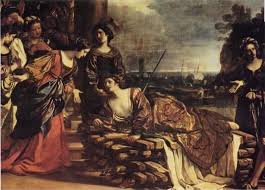
I did not love epic poetry at first sight. But by the time Dido stabbed herself on top of her own funeral pyre, I was hooked.

I was studying Latin by accident, really, through a long set of changes in undergraduate majors so convoluted I won’t bother to mention them here. Suffice it to say: I was one of those misguided youths who believes “professor” sounds like a good career choice. Professor of What? Hadn’t decided. Whatever. I just wanted to teach at a college. I believe at that time I thought I was going to be a Russian Medievalist. Some German professor told me it would be the next hot thing.

Not sure what Latin had to do with Old Church Slavonic, but I was studying it; I had even made it to my fourth semester. Some fantasy that I was in a British schoolboy must have gotten me through the third semester, because it sure as heck wasn’t the writings of Julius Caesar or Cicero that kept me going. I was at Brigham Young University, which isn’t much like an English boarding school. I was a college sophomore, a closeted twenty-three year-old virgin. A thirteen year-old Etonian would have been a corrupting influence on the likes of me.

My education had been sheltered enough that I’d somehow made it that far that I’d not only missed ever being exposed to the Aeneid in some translation before, I’d never even read an excerpt of the Odyssey. I remember buying the Purple Vergil, a hardback standard inflicted on generations of Catholic schoolchildren, no doubt. I remember the wonder at seeing all those lines. Every one the same length. As otherworldly as it seemed, I couldn’t imagine that anyone had ever made it through the whole thing. Twelve books. We had sixteen weeks to cover only the first four. A line could take me an hour. Each book had about 800 lines. It took Vergil the last eleven years of his life to write it. At the rate I was going I would have to live a lot longer than Vergil’s 51 years to make it through.

Then along came Dido. This was before a certain British pop singer had come along, so the name itself was strange. Even in the halting pace I kept though all the parsings—ablatives, datives, subjunctive mood shifts—Dido breathed. Duty-bound Aeneas’ pietas was as humanizing for me as a plaster wall. But the Queen of Carthage’s rage was something I understood. Two millennia later, in dactyls, in a language I could barely make a sentence of she burned.

Listen to the Aeneid IV in the original Latin.


That’s how it began: my love affair with the poetry of other people’s languages, my troubled relationship with the long poem. Long before I’d ever love my own language, let alone want to fashion my own Dido out of it.

Here's Dido's death as translated by Robert Fagles:
Then Juno in all her power, filled with pity
for Dido's agonizing death, her labor long and hard,
sped Iris down from Olympus to release her spirit
wrestling now in a deathlock with her limbs.
Since she was dying a death not fated or deserved,
no, tormented, before her day, in a blaze of passion--
Prosperina had yet to pluck a golden lock from her head
and commit her life to the Styx and the dark world below.
So Iris, glistening dew, comes skimming down from the sky
on gilded wings, trailing showers of iridescence shimmering
into the sun, and hovering over Dido's head, declares:
"So commanded, I take this lock as a sacred gift
to the God of Death, and I release you from your body."

With that, she cut the lock with her hand and all at once
the warmth slipped away, the life dissolved in the winds

It's Like Epic Man


Nights are long around the fire. Winters especially.

The sun’s gone down early, you’re sitting on a charred rock chewing on wild goat jerky wishing there were something on tv, wishing you could update your Facebook status, but it’d just be the same old thing:

“Remembering my old clubbing days, lost a spear today, God, I miss the Ice Age.”

But see, there’s this wacked-out dude in the tribe, every tribe’s got one like him, he’s like blind and that sucks and all ‘cause he can’t even watch the fire, so he must be really bored. So bored he starts like pounding on some dried out skin tied to a log the tribe uses like a pot (The tribe’s still figuring out this newfangled ironsmithing stuff; it’s like harder than the old days when you like had to program a VCR and shit.) So the blind dude, everyone calls “Homer” probably because he’s got this mammoth beergut. You say beergut, but the tribe’s still mastering the whole agricultural thing. No hops=no beer. So, who knows how he got fat, it sure wasn’t off this effin jerky.

DUM-dum-dum DUM-dum-dum DUM-dum DUM-dum-dum DUM-dum-dum DUM DUM

Homie pounds out on the goat skin, and then the dude starts mumbling to himself. He’s like calling out to some chick called, Mousa, which is kind of a sucky name for a chick, you think. But, like, no sooner has he called out her name than he gets all possessed, like Linda Blair and shit. But the stuff that comes out of his mouth, man. This ain’t no green vomit, dude.

It’s, like, epic, man.

The What For Question

A student approached a colleague after class one day. The day’s lesson in English as a Second Language had been on some difficult grammatical concept native speakers take for granted, sequence of tenses, let’s say. The student looked her teacher earnestly in the eye and asked, “What for, Victoria? What for?”

That student’s question sticks in my head. It’s one I’ve been asked—that is, in spirit—whenever someone finds out I’m writing a novel in verse. Why would a person want to do that?

The question comes from fellow writers as much as it does from those who do not aspire to write. If the writer doesn’t write poetry, the question is usually practical. Why, if a person wants to write a novel, wouldn’t he just write a novel? Who reads poetry anyway? With Prosers, the problem’s fear. They’ve had some pretty heavy verse thrown at them in bite-sized chunks, so dense it’d take a winter to chew. They think, as Billy Collins put it, they must “tie the poem to a chair with rope/and torture a confession out of it.” Poem as enemy insurgent, as foreign combatant.

If the writer’s a poet, the “What For Question” ultimately stems from the fact that almost no Poet wants to read anyone else’s poem if it might be longer than one page. This aversion seems to apply to any poem, no matter how short the line. You could have a poem with three syllable lines, hand it to a fellow Versifier, I guarantee she’ll look at the staple first, then say something like, “Oh, it’s long.” Give her a week to read it, a week later the Poet’ll say, “So sorry, I didn’t have time.”

When I began writing Constance, Or, I finally had to abandon the poetry workshop—like our first parents did the Garden. They’d been halcyon, those days in the workshop, but I’d been pushing it for years. First two. Then four. I’d even agree just to take it one stanza per week, but then invariably some Poetaster would be upset that they had been expected to remember what someone else had written, like longer than five minutes.

I make fun of the poets, but I’m worse than any of them. The truth of the matter is this: I read novels. I write verse. It was inevitable, like those old Reese’s Peanut butter cup commercials, one day my novel was going to land in my verse.

Two great tastes that taste great together?

We’ll see.

Saturday, December 4, 2010

The A-Frame


The A-Frame

Daddy is an early riser. Always has been. Long before there was a fitness craze, he would jog a half hour before he’d eat his daily pan of oatmeal mush. As his knees aged, cycling replaced the morning run. Every day but the Sabbath. And on the Sabbath he’d complain: got too tired when he didn’t exercise. This seemed ridiculous. How could a man whose job as a mechanic, most of his work with buses and ranchers’ trucks, need any more physical exertion? He’d be at work at his shop, a mere three blocks away, before eight. Seemed to me if anybody could justify sleeping in, it’d be him. He was his own boss, those early hours made no sense.
Now that I’m a man, I get up at five most mornings, an hour earlier than my father ever did. It used to be I’d wake up that early so I’d have time to putter, drinking too much tea after a long shower. Eating fried eggs, masturbating and watching the BBC—simultaneously. By the time I’d leave for work, the bed would be piled high with outfits I’d tried on and rejected before settling on something in a panic. I’d catch a train that would inevitably get me 15 minutes late to my teaching gig an hour and forty minutes away.
As I’ve aged, thank goodness, the morning ritual has changed. Things are simpler now, especially since I started writing the novel. The alarm still goes off at 5 and I still multitask: I eat my cereal in the shower. I quit masturbating and the BBC. Instead I pack a Thermos in a backpack and pull out the yoga mat. By 6:33 I blow out the candles, put on a shirt and tie. I’m out the door in time to sit a couple before the 6:44 Brooklyn-bound B.
The trick of limiting the chaos and getting to work 40 minutes early is probably not the novel at all, but when I have my tea. My first steamy capful is the reward I get for making it to the train. Sipping, I open a Moleskine blankbook sideways. I draw a left margin across two pages. Then I pencil fourteen crossbeam lines shooting out from the margin right. I number them left. I aba bcb cdc ded ee them on the right. This is the scaffold I use to build my book.
I inherited, or rather was taught, my love of literature from Mother. The need to build, however, I get from Daddy. He comes from a line, his father and grandfather before him were tinkers. I don’t know what Grandpa Jensen did for a living, nothing steady besides trapping coyotes, odd repairs and carpentry. But our tumbleweed town has a couple of buildings worked on, not least among them, Daddy’s shop and the one-screen movie house. The tea-colored pattern of leaks on the ceiling were often as interesting to me as a child as any of the films the Valley Theater showed. Only when I was grown would I realize: those stains were Grandpa’s handiwork.
As if tinkering with cars is not enough, Daddy also builds. He built the second of our two family houses. It is located not in some picturesque remote location. Not that it wouldn’t fit such a locale: it’s painted in chocolate brown with turquoise scalloped trim. I’ve never been to Switzerland, but our second home looks like what I imagine chalets look like. Not that Swiss chalets are a-frames like ours. And the A-frame sits not by some Alpine lake, but in our backyard. Right behind our regular house. A hallway leads to it, crooks to the right and inclines. It opens to the A-frame’s family room. Its peaked open ceiling. South facing, full of light. The smell of pine dust from the unvarnished beams of the ceiling that slope down nearly to the floor.
So I’ve been writing this novel in sonnets going on two years. I don’t know when in the process I began thinking of it as the equivalent of Daddy’s A-frame. But the analogy doesn’t work very well, as you’ll see.
Our A-frame had no blueprint. Daddy built it over several years from a plan that existed in his head alone. He never even made a sketch.
Not so with Constance, Or (that’s the title of my novel). Each page of each draft scribbled over back and front, a 60,000 word Ur-Constance written in prose was printed off in 2006 as part of the National Novel Writing Month. At the end of the month I printed what I'd written, put it in a file and abandoned it.

The verse incarnation of Constance, Or is only 90 pages long to date, but my sketches for it could paper the walls of a cathedral.
That’s a lot of cutting, and a sawhorse is actually an a-frame. It needs to be to withstand the pressure. Something that stuck from high school geometry: triangles are the strongest shape. I guess that’s why the design is used so much for cabins: the roof steep and strong enough to bear a mountain’s snow. But if an a-frame’s strong, it’s also simple. No need for columns. Can’t get simpler than that.
But there’s nothing simple to the structure of my verse novel. Would that it were so. It has flashbacks within flashbacks. Subplots, dozens of characters. Two years in and I’m just beginning to be able to understand why this story must be told in verse, but don’t ask me to explain that to you. I can’t vocalize it yet. I do know what the ending should be, but how (or when) I’ll ever get there is a mystery. And that’s where the analogy to the A-frame begins to fit.
Two of the greatest verse novels in the history of the sub-sub genre were never finished. Byron’s Don Juan (pronounced for comic effect “Joo-wan,” by the way) and Pushkin’s Evgenii Onegin (that's Eugene for those of you who want a similar Byronic spin) both only exist in fragments. Both consumed far more time than either of the short-lived poets had; Byron and Pushkin had untimely deaths to meet. I've outlived them both which is likely to be the only accomplishment I will ever have on them. And at the rate I'm writing Constance, Or, I may have to outlive them a very long time before I see it finished.
Daddy's A-frame will never be completed. Its rafters will remain unvarnished after my father is gone. It's just three rooms: the family room, then a loft reached by a winding, cold, iron stair, and a bathroom that never has (and never will have) plumbing. It's sturdy and I think it's lovely, but the house that Daddy built is a failure on many accounts. Because it's electric heat is too expensive and the wood-burning stove Daddy welded together from steel plates at his shop can't heat the place very well.
We visit it often, but only two people ever really lived there. My brother did through his high school years. When he left home and I wanted to take over the loft, I was told no. My room across from Mother would do.
The only other person who ever slept there regularly was a German exchange student I fell for first-sight my senior year. When his original homestay in a trailer with a family of six fell through, he moved in (after much conivving on my part). In the apex of the A-frame, he slept that winter in sweaters and heating bills were added to the list of things that were just not right about him being there.
Now the only thing that stays in the family's second home permanently is junk. The “bathroom” houses every outfit mother ever wore; the family room is crowded with yard-sale games her grandchildren will never play with.
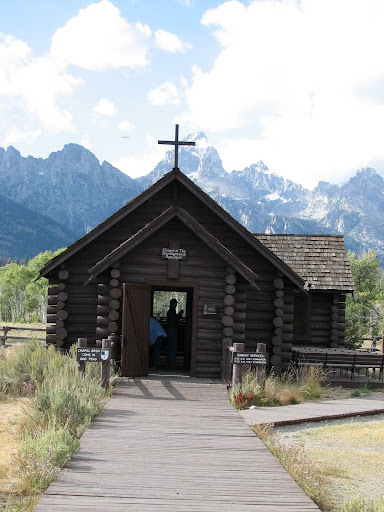
See: a-frames are impractical once you’re inside. The first non-Mormon chapel I ever set foot in was an a-frame in Yellowstone, the Teton peaks beyond were its stained glass. A-frames might do for weddings, but not for living. The ceilings are the walls and that makes for a lot of wasted space. They’re hard to insulate because once you do, you lose the beauty of the frame. Those alpha rafters repeating themselves in wood, over and over again. It’s like living inside a window you can’t bring yourself to close the drapes on.
I hope it won’t seem like a bad case of “Stinkin’ Thinkin’” but this verse novel idea of mine is doomed to fail. In the age of Twitter, contemporary readers might struggle through one sonnet, but three hundred? That’s a challenge for even a hardboiled poetry reader. But impracticality won’t keep me from writing it. From spending almost every spare moment I have fashioning it. Daddy worked on the A-frame Saturdays when work at the shop didn’t keep him too long and when the weather wasn’t too nice enough to waterski. He tinkered on the thing for five years or more.
All poets are tinkers. “Poetry,” “poems,” “poet” all come from the Greek word “poi-oh” which means “I make,” but might as well mean, “I toy.” We poets fiddle with language, image and emotion. We tear apart the world to see its smallest mechanisms, its gears, springs and pulleys. Sometimes some poet like me gets an idea to toy with something giant. Not only to tear apart but build.
And I build what I call a novel in the backyard of my home: on New York subways, in parks, on nude beaches and Harlem laundries. Surrounded by porn stars and prostitutes in the gayest gym in Manhattan you’ll find me: counting stressed and unstressed syllables between weight-lifting sets. Stuffing my novel with discarded bits of family junk.
Sometimes on the Sabbath Daddy will go missing. You’ll find him in the A-frame. He can’t hear Mother raging from there. Daddy lays on the floor staring up into the stuttering alphabet he raised. I write best in the morning because Mother’s voice stuck in my mind, on constant loop, plays loudest then. Writing shuts her up. And so I write, building one sonnet two-by-four at a time a tribute of sorts to my father.
A tribute, I can only pray, he will never ever see.